
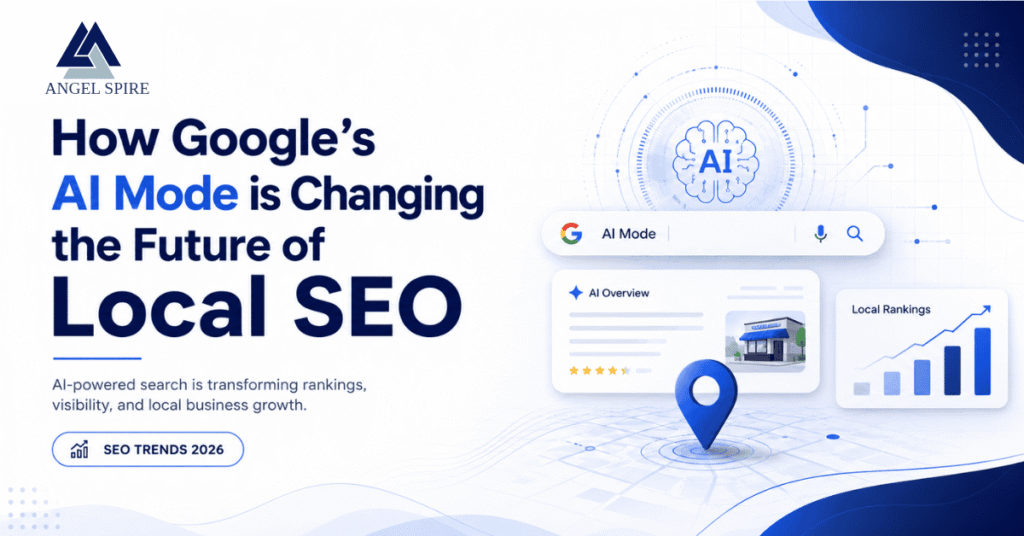
Google’s AI Mode is transforming the way people discover businesses online by delivering conversational, AI-generated answers instead of traditional search result pages. Rather than showing endless blue links, Google now understands user intent, summarizes information, and highlights only the most relevant brands and businesses. For any modern business, partnering with a forward-thinking digital marketing agency like Angelspire is becoming essential to improve visibility, strengthen local SEO, and stay competitive in the evolving AI-powered search landscape.
That matters deeply for local SEO because local discovery has always depended on visibility at the moment of intent. When someone searches for a dentist, accountant, salon, or marketing agency nearby, they often choose from the first trusted options they encounter. If AI Mode narrows those options before a user ever scrolls, businesses face a much more selective discovery environment.
In earlier local SEO strategies, businesses could achieve visibility through category relevance, proximity, backlinks, and profile optimization, but today AI SEO for local businesses requires stronger trust signals, conversational relevance, and adaptation to ongoing Google AI search updates. In the AI-era local search model, those factors still matter, but they now sit inside a more complex trust system that also evaluates review quality, data consistency, and whether the business can be confidently recommended in a conversational answer.
This is why Google’s AI Mode is not just another SERP feature. It is part of a broader move toward AI-mediated decision support, where Google attempts to reduce friction for users by summarizing, comparing, and filtering choices before a click happens.
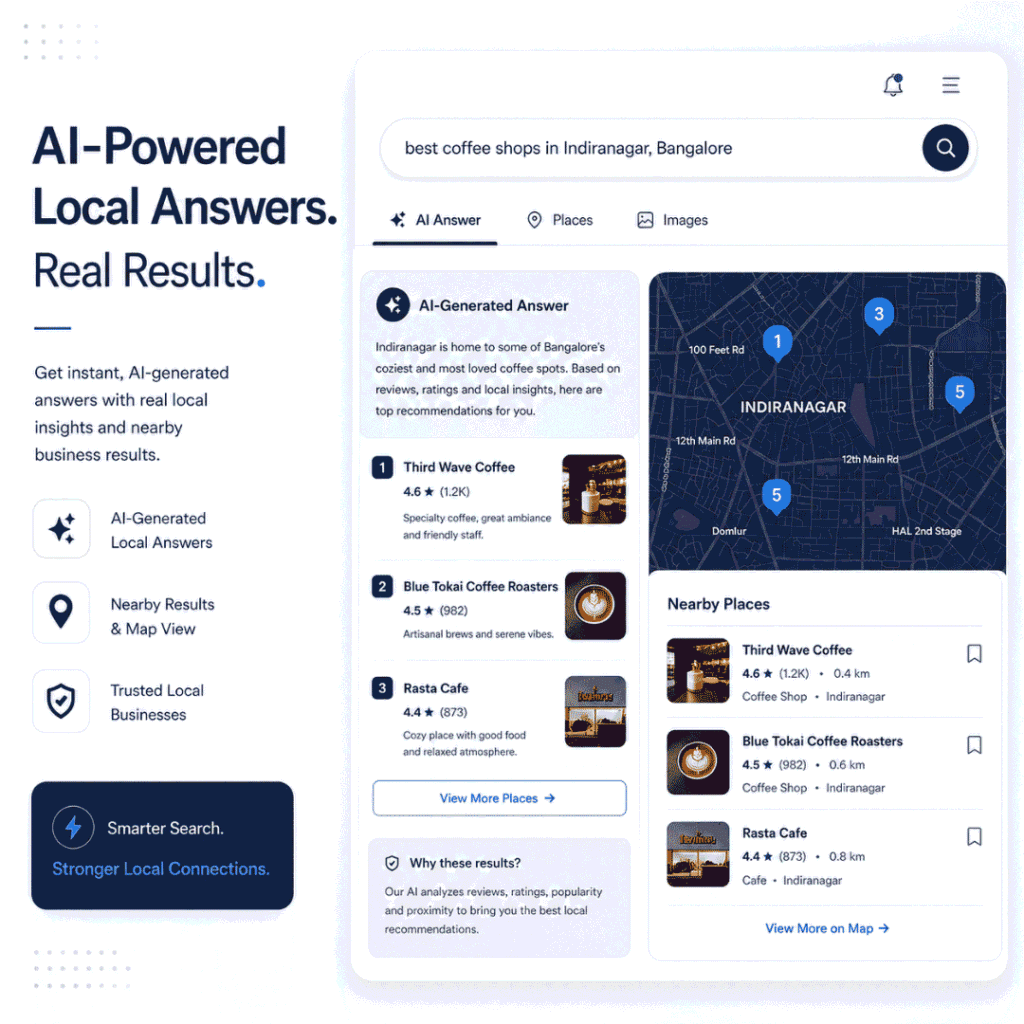
Table of Contents
ToggleKey Takeaways
- Google’s AI Mode reduces reliance on simple blue-link rankings and increases the importance of synthesis-ready business information.
- Local visibility in AI systems is significantly harder to earn than traditional local pack visibility, which raises the bar for trust, consistency, and differentiation.
- Reviews, business profile accuracy, and ecosystem-wide consistency now influence whether a business is even considered for AI-powered local recommendations.
- Zero-click behavior is rising, so smart local SEO now focuses on visibility, brand recall, and conversion quality, not just traffic volume.
- Businesses that answer local questions clearly and structure content around real buyer intent are better positioned for AEO, GEO, and AI Overview visibility.
- Google’s AI Mode rewards businesses that build authority consistently, which is why investing in organic business growth strategies is becoming increasingly important for long-term local SEO success.
Why AI-Driven Search Will Redefine Local SEO in 2026
In 2026, AI-driven search is no longer experimental behavior at the edges of search. AI Overviews reach 2 billion monthly users, and Google AI Mode has already reached 100 million users in the US and India, showing that AI-assisted search is becoming part of mainstream user behavior.
This scale changes local SEO because user expectations are changing with it. People increasingly ask natural-language questions, expect an answer immediately, and often treat the search interface itself as the final destination rather than the first step in a browsing journey.
For local brands, the shift is especially important because AI systems are more selective than traditional search. According to SOCi data summarized by Search Engine Land, only 1.2% of locations were recommended by ChatGPT, 11% by Gemini, and 7.4% by Perplexity, compared with 35.9% visibility in Google’s local 3-pack.
That gap means businesses can no longer assume that strong local pack rankings will carry over into AI-driven discovery. In practical terms, Google’s AI Mode is changing the future of local SEO by moving the competitive threshold from “can this business rank?” to “can this business be confidently recommended?”
This distinction is critical for agencies and in-house teams developing local SEO strategies 2026 because how Google AI affects local SEO now depends more on recommendation quality, entity trust, and AI search optimization for local business visibility than traditional ranking signals alone. Ranking well remains useful, but recommendation-readiness is becoming the stronger signal of future performance.
Businesses that want to stay visible in this new AI-first search environment must move beyond traditional optimization and adopt smarter, recommendation-focused strategies. At Angelspire Digital Marketing Agency, our SEO services are designed to help brands adapt to evolving search behavior through entity optimization, local authority building, AI-ready content strategies, and advanced local SEO frameworks. As Google’s AI systems become more selective about which businesses they recommend, investing in future-focused search engine optimization is no longer optional — it is essential for sustainable local visibility and long-term digital growth.
Business Advantages of Adopting AI-Focused Local SEO Early
Businesses that adapt early to Google’s AI Mode gain a strategic edge because they improve not only search visibility, but also message clarity, trust signals, and conversion quality. The same work that helps a business become citation-ready for AI often improves traditional SEO fundamentals too.
One benefit is stronger local trust. When profiles, reviews, service pages, and external listings tell the same clear story, AI systems can interpret the brand with less uncertainty. That consistency also helps real users feel more confident about contacting or visiting the business.
Another benefit is higher-quality traffic. Semrush reports that AI search visitors can be more valuable than traditional organic visitors, and AI-referred sessions may show lower bounce rates and stronger engagement in some contexts. That means fewer visits do not always mean weaker business results.
There is also a content efficiency benefit. When teams build pages around conversational questions, direct answers, local proof, and entity-rich explanations, those assets can support Google AI overview SEO, featured snippets, local landing page performance, and even off-platform AI search optimization for local business visibility.
Finally, early adaptation reduces strategic risk. Businesses that wait may find themselves optimized for yesterday’s local ranking factors while competitors build stronger profiles for AI powered local search and future of local SEO with AI discovery models.
How Google’s AI Mode Is Redefining Local Business Discovery
Google’s AI Mode is changing how customers discover nearby businesses by prioritizing conversational intent and recommendation accuracy instead of simple rankings. Traditional SEO methods still matter, but the future of local SEO with AI now depends on trust signals, review sentiment, entity consistency, and structured business data. Businesses adapting early to AI powered local search are more likely to appear in AI-generated recommendations and Google AI overview SEO results. This shift also highlights how AI is changing SEO from a traffic-driven strategy into a visibility and authority-driven ecosystem. For brands planning long-term local SEO strategies 2026, optimizing for AI understanding is becoming just as important as optimizing for keywords and backlinks.
Why AI SEO for Local Businesses Requires a New Content Strategy
AI SEO for local businesses now requires content that answers real customer questions clearly and conversationally. Google’s AI Mode evaluates whether a business can confidently solve user intent, which means thin pages and outdated local content are losing visibility. Businesses must create detailed service pages, FAQs, review-focused content, and locally relevant explanations to improve AI search optimization for local business growth. This evolution also reflects the broader AI impact on local SEO, where search engines increasingly reward trustworthy and context-rich information. Brands that adapt to Google AI search updates early can build stronger authority across both traditional rankings and AI-generated local search experiences.
Future of Local SEO With AI and Conversational Search
The future of local SEO with AI will revolve around recommendation-based visibility rather than only position-based rankings. Google’s AI Mode is already encouraging users to interact with conversational search interfaces that provide summarized answers instead of long lists of websites. This creates both opportunities and challenges for local brands trying to improve visibility in AI powered local search environments. Businesses that maintain strong reviews, optimized profiles, and accurate entity signals across the web will have a greater chance of being recommended by AI systems. As local business SEO trends continue evolving, companies must combine traditional SEO foundations with AI-focused optimization strategies to remain competitive in 2026 and beyond.
Emerging AI Search Trends Influencing Local Business Visibility
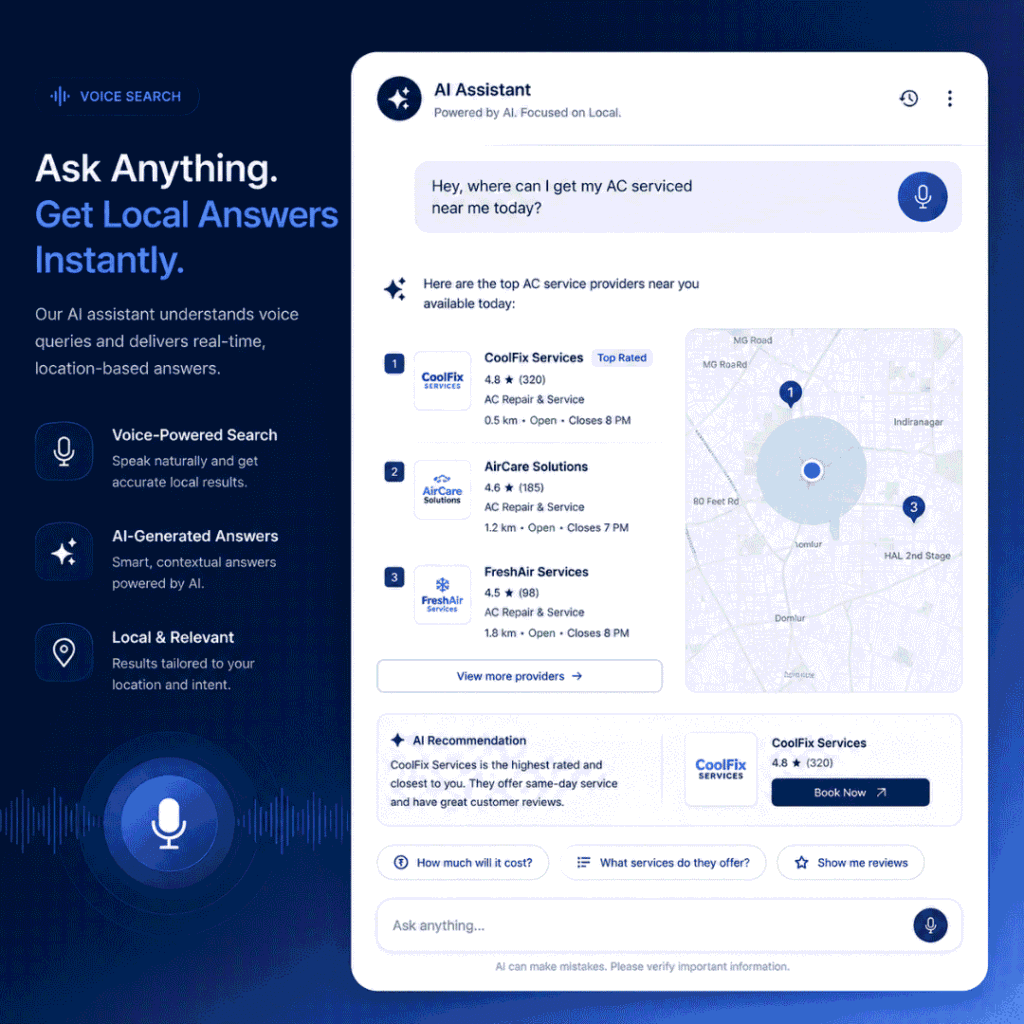
One of the clearest trends is the rise of zero-click behavior. Semrush notes that roughly 60% of searches now yield no clicks, and when AI summaries appear, users are less likely to click traditional organic listings below them. This does not eliminate SEO value, but it changes what success looks like.
Another major trend is the growing value of source inclusion over position alone. If a brand is mentioned or cited in an AI-generated answer, it can still benefit from visibility, trust, and assisted conversion even when the user does not click immediately.
Local search is also becoming more reputation-sensitive. Search Engine Land’s reporting on SOCi’s local visibility data shows that AI systems favor higher-rated businesses and use reviews more like a qualification filter than a simple ranking signal. In other words, businesses with weak sentiment may disappear from AI recommendations even if they remain visible in standard local search.
A further trend is ecosystem dependence. AI systems increasingly draw confidence from multiple sources such as Google Maps, brand sites, Yelp, Facebook, and other trusted data environments. That means local SEO is becoming less about isolated page optimization and more about maintaining a coherent business entity across the wider web.
The final trend is conversational query mapping. Users are shifting from short phrases to detailed questions, which increases the value of FAQ-driven content, service-explainer pages, and comparison sections that answer realistic local buying questions such as price, timing, suitability, availability, and trust.
Key Local SEO Challenges Created by AI-Powered Search Systems
The biggest challenge is reduced visibility surface area. Traditional local search could show a map pack, organic results, ads, directory pages, and more. Google’s AI Mode may compress that discovery path into a summarized answer with only a few recommended options, making competition much tighter.
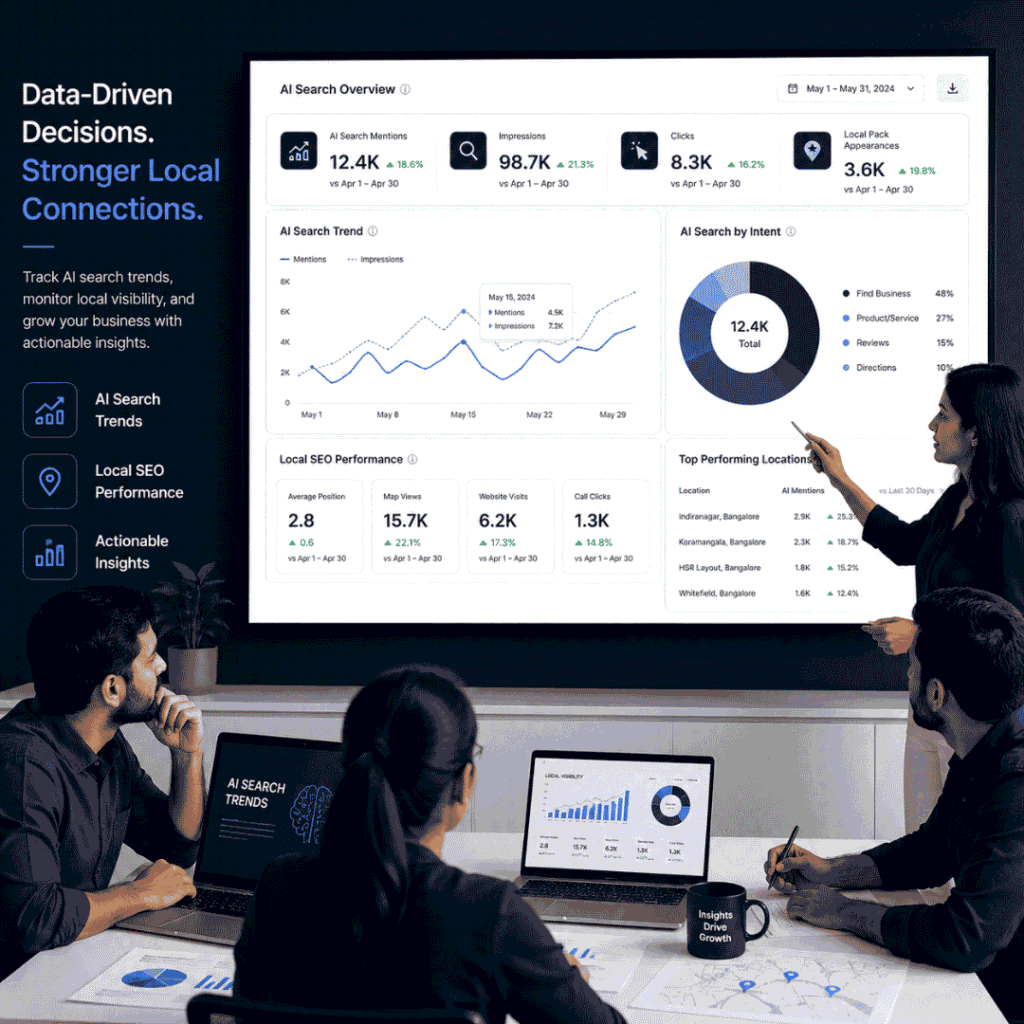
A second challenge is measurement. Classic SEO teams are used to tracking rankings, impressions, clicks, and conversions. In the AI era, they also need to assess citation frequency, brand mention share, profile completeness, sentiment quality, and conversion performance from lower-volume but higher-intent sessions.
Another challenge is operational complexity. Local AI visibility depends on multiple moving parts: Google Business Profile accuracy, review generation and response, schema implementation, local page quality, directory consistency, and content that aligns with real conversational demand. Weakness in one layer can reduce trust in the whole entity.
There is also a trust challenge. AI answers are still not perfectly accurate, and users remain skeptical of them. Semrush’s compiled statistics note that many users have seen inaccurate or misleading AI Overview content, so businesses need exceptionally clear, verifiable, and well-sourced information to stand out as reliable.
Smart Optimization Strategies for AI-Ready Local SEO Success
Google’s AI Mode rewards businesses that combine strong local fundamentals with machine-readable clarity and buyer-facing trust signals. The most effective strategy is to treat local SEO, AEO, and GEO as one connected discipline rather than three separate workstreams.
Strengthen your Google Business Profile
A complete and accurate Google Business Profile is now one of the strongest foundations for local AI visibility because it gives Google a verified source of truth about your business, services, hours, categories, location, and trust signals. In AI-led local search, incomplete or inconsistent profiles increase the chance of being filtered out before the user even sees your business.
Priority area | What to optimize | Why it matters |
Core data | Business name, address, phone, hours, categories | Improves consistency and reduces entity confusion for AI systems. |
Trust signals | Reviews, photos, responses, business verification | Helps AI judge whether the business is safe and credible to recommend. |
Relevance | Services, products, attributes, Q&A | Improves fit for conversational and specific local queries. |
Detailed execution starts with accuracy. Every field in the profile should match the website and major citations. Categories must reflect the true core service, secondary categories should support real business offerings, and hours need frequent updates. Reviews should be managed as strategic trust assets, not passive social proof. Teams should also publish photos and keep service details current because stale or incomplete profiles create uncertainty for both users and AI.
Build citation-ready local content
Citation-ready local content is content that answers common local questions directly, supports claims with proof, and makes it easy for AI systems to extract and reuse key points. This means writing for clarity, structure, and trust rather than relying only on keyword repetition.
- Use question-based H2s and H3s that reflect real conversational searches.
- Answer the question in the first paragraph with a clear, concise explanation.
- Add proof through examples, service specifics, pricing context, timelines, or case evidence.
- Support local relevance with neighborhood, city, or service-area context where appropriate.
In practice, this means upgrading thin city pages into decision-making resources. A strong local service page should explain who the service is for, what problems it solves, how quickly the business can help, what makes it credible, and what a customer should do next. That style of writing improves how Google AI affects local SEO performance because it aligns with both user intent and AI extraction logic.
Improve entity consistency across the web
Local AI systems rarely rely on one source alone. They compare business information across a network of platforms and are more likely to recommend entities that appear stable, well-defined, and trustworthy across those environments.
That makes NAP consistency, service alignment, and brand description consistency more important than ever. The website, Google Business Profile, social profiles, maps citations, and review platforms should all reinforce the same core identity. This is especially important for multi-location businesses, service-area businesses, and brands with franchise or partner models.
Treat reviews as recommendation signals
In classic local SEO, a business could sometimes rank despite average reviews if proximity and relevance were strong enough. In AI-led local search, review quality increasingly functions as a gating factor that helps determine whether a business is safe to recommend.
That means local businesses need an active review system. Ask for reviews after successful service moments, respond to negative feedback constructively, and look for recurring language in customer feedback that can inform site copy. Reviews often reveal the exact trust phrases prospects care about, such as responsiveness, price fairness, cleanliness, speed, or expertise.
Use structured data to support machine understanding
Structured data does not guarantee inclusion in AI responses, but it helps search systems interpret facts about a business, its services, FAQs, locations, and content topics. This improves clarity and reduces the chance that useful information remains hidden in unstructured page copy.
For local businesses, the most useful schema types usually include LocalBusiness, Service, FAQPage where appropriate, Review, and Organization. The key is not to over-mark up everything, but to ensure that important business facts, offerings, and answer-friendly content are represented clearly.
Redefine success metrics
Local SEO teams need to expand measurement beyond rankings and traffic. In AI environments, visibility without clicks can still influence branded search, direct visits, calls, and assisted conversions.
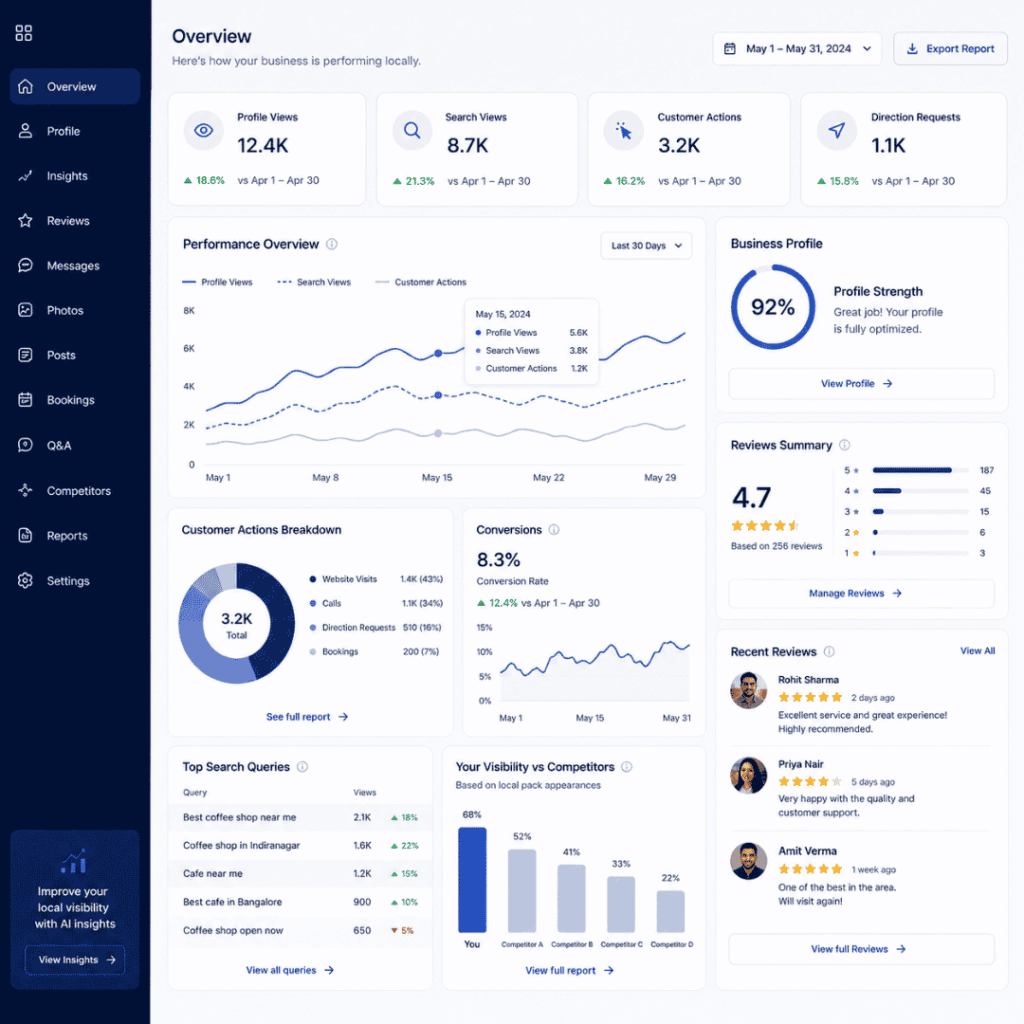
A better reporting model tracks local pack performance, branded search growth, review velocity, profile actions, AI citation presence where measurable, organic conversions, lead quality, and close rate from organic and AI-referred traffic. This is where sophisticated agencies can show business impact even when clicks fluctuate.
Common Mistakes to Avoid
Google’s AI Mode
- One common mistake is treating Google’s AI Mode like a simple extension of standard SEO. Businesses that only tweak title tags or add a few keywords may miss the deeper issue, which is whether the business can be confidently summarized and recommended by AI systems.
- Another mistake is over-focusing on traffic while under-focusing on conversion and visibility quality. Because AI can reduce clicks, some businesses misread performance changes as total loss when the better question is whether remaining visits are converting better and whether brand visibility is still improving.
- A third mistake is neglecting local proof. Thin location pages, generic service descriptions, outdated hours, and weak review management send low-confidence signals. In local AI search, generic pages are less useful because the system is trying to recommend the best-fit answer, not just list possible options.
- There is also a content quality mistake: publishing generic AI-generated text with little firsthand value. E-E-A-T matters more in AI-shaped search because systems need trustworthy material they can cite without increasing risk. Pages that add original examples, practical detail, and specific expertise have a stronger chance of standing out.
The Next Phase of Local SEO in the Era of Google AI Search
- The future of local SEO with AI points toward fewer visible options, more recommendation filtering, and stronger dependence on trusted entity signals. As AI Mode and AI Overviews continue to expand, local businesses will need to optimize not just for discoverability, but for recommendation eligibility.
- This likely means stronger integration between website content, business profile management, reputation marketing, and conversion optimization. The local brands that win will not necessarily be the ones with the most pages, but the ones with the clearest trust signals, best data consistency, and strongest evidence that they solve a specific local need well.
- It also means local content will become more neighborhood-aware and more use-case specific. Broad city-level targeting will still matter, but deeper relevance at the service-area, scenario, and decision-support level will play a bigger role in how AI systems select which businesses to surface.
- For agencies such as Angelspire, this shift creates a strong strategic positioning opportunity. Businesses need a partner that understands how Google AI search updates are changing local discovery and how to build a local SEO system that works across classic search, AI Overviews, and conversational search interfaces.
Conclusion of Google's AI Mode
- “Google’s AI Mode is transforming the future of local SEO by shifting search from a ranking-focused experience to an AI powered local search ecosystem where Google synthesizes data, interprets intent, and selectively recommends businesses through conversational results and Google AI overview SEO experiences.
- For Angelspire, the strongest positioning is to help local brands build AI-ready local search systems instead of chasing outdated ranking tricks. That means combining content strategy, Google Business Profile optimization, review systems, schema, and conversion-focused local pages into one coordinated growth framework built for 2026.
About The Author
Angel Sargiya
Angel Sargiya is a digital marketer and founder of Angelspire, passionate about helping brands grow through SEO, AI-driven marketing, content strategy, and performance-focused digital campaigns. With expertise in local SEO, organic growth, and modern search trends, Angel creates actionable insights that help businesses stay ahead in the evolving digital landscape.
CTA
If your business depends on local discovery, now is the time to audit how visible, accurate, and recommendation-ready your brand is across Google’s AI Mode, AI Overviews, Google Business Profile, and key third-party platforms. Angelspire can turn that audit into a practical roadmap that improves local search resilience, qualified leads, and long-term AI visibility.

Frequently Asked Questions
The 80/20 Rule in SEO, also known as the Pareto Principle, means that 80% of organic traffic and Google rankings usually come from 20% of your SEO efforts. A few high-performing pages, keyword optimization strategies, and quality backlinks often generate most website leads and conversions. Businesses improve SEO performance by focusing on technical SEO, high-intent keywords, user experience, and content marketing strategies instead of optimizing every page equally. This SEO strategy helps brands increase organic traffic growth, improve search engine rankings, and achieve better ROI from digital marketing campaigns.
The 10-20-70 Rule for AI explains that successful AI implementation depends more on human strategy than AI tools alone. Around 10% depends on AI technology, 20% on data quality, and 70% on human creativity, SEO expertise, and decision-making. In AI-powered SEO and digital marketing, tools like ChatGPT help automate content optimization, keyword research, and SEO analysis, but businesses still need human-led SEO strategies for better user engagement, search engine rankings, and content quality. This balance improves long-term digital marketing performance and organic visibility.
No, AI-generated content is not bad for SEO when it is original, useful, and optimized for search intent. Google Search Central focuses on content quality, user experience, and relevance rather than how content is created. AI content marketing can improve SEO blog writing, meta descriptions, and content optimization when combined with human editing and fact-checking. However, spammy AI-generated articles, duplicate content, and keyword stuffing can negatively affect Google rankings. Businesses using AI-powered SEO with human expertise often achieve better organic traffic and higher search visibility.
Yes, AI can improve SEO by helping businesses automate keyword research, technical SEO audits, competitor analysis, and content optimization. AI SEO tools analyze user behavior, identify low-competition keywords, and improve search intent targeting for better Google rankings. In 2026, AI-powered SEO also supports voice search optimization, semantic SEO, and personalized search experiences. Businesses combining AI for SEO with human expertise can create high-quality content, improve organic traffic growth, and increase website conversions through smarter digital marketing strategies.
Nearly 85% of AI projects fail because businesses focus too much on AI technology and ignore strategy, data quality, and customer needs. Common AI implementation challenges include poor planning, weak SEO strategies, lack of skilled teams, and overdependence on automation. In digital marketing and SEO, relying only on AI tools often creates low-quality content and poor user engagement. Successful AI adoption requires human creativity, continuous optimization, ethical AI usage, and strong content marketing strategies to improve long-term SEO performance and business growth.
No, Google does not automatically penalize AI-generated content for SEO. Google Search Essentials ranks content based on usefulness, originality, and E-E-A-T guidelines rather than whether AI created it. AI-generated articles can rank well when they provide value, satisfy search intent, and include proper SEO optimization. However, low-quality AI spam content, keyword stuffing, and misleading information may reduce search engine rankings. Combining AI content generation with human editing helps businesses create trustworthy and SEO-friendly content.
AI is changing SEO in 2026 by making search engines smarter, more conversational, and focused on user intent. AI-powered Google search now prioritizes semantic SEO, voice search optimization, personalized search results, and helpful content. Businesses must create high-quality, intent-focused content instead of only targeting keywords. AI tools also improve technical SEO, predictive keyword analysis, and content optimization for better search visibility. Brands adapting to AI-driven SEO trends in 2026 are achieving stronger organic traffic growth, better rankings, and improved user engagement.
The best AI for SEO depends on your goals, budget, and content strategy. ChatGPT is widely used for SEO content writing, keyword ideas, and content marketing strategies. Tools like Surfer SEO and Semrush help with keyword research, competitor analysis, technical SEO, and on-page optimization. Businesses using multiple AI SEO tools with human expertise can improve organic traffic, search engine rankings, and overall digital marketing performance more effectively.