
Table of Contents
ToggleIntroduction
B2B SaaS marketing strategies are evolving faster than ever before as SaaS growth marketing becomes more competitive, data-driven, and AI-powered in 2026. What worked in 2022 is already outdated. In 2026, the competition is sharper, buyer behavior has shifted dramatically, and the old playbook of cold emails and generic ads simply won’t cut it anymore.
If you’re running a SaaS company — or you’re the marketing leader tasked with growing one — this blog is for you. Whether you’re a startup looking to get your first 100 customers or an established SaaS brand trying to break the $10M ARR ceiling, understanding the right B2B SaaS marketing strategies for 2026 is no longer optional. It’s survival.
At Angelspire, we’ve worked with dozens of SaaS companies across industries to build marketing engines that drive real, compounding growth. In this guide, we’ll walk you through everything you need to know — from the foundational principles to the cutting-edge tactics that are defining the B2B SaaS marketing landscape in 2026.
Introduction to B2B SaaS Marketing Strategies for 2026
B2B SaaS marketing is the art and science of attracting, converting, and retaining business customers for software-as-a-service products. Unlike traditional product marketing, SaaS marketing is subscription-driven, which means the relationship with the customer doesn’t end at the sale — it’s just beginning.
In 2026, the definition of “good” B2B SaaS marketing has expanded. It’s no longer just about generating leads. It’s about generating the right leads, converting them efficiently, and keeping them for years. The full customer lifecycle — from awareness to advocacy — is now firmly in the marketer’s domain.
The global SaaS market is projected to exceed $700 billion by 2026, according to data from Gartner and Statista. Within that, B2B SaaS is the dominant segment, with thousands of new entrants each year. This creates an environment where differentiation is everything and attention is the scarcest resource.
Angelspire has identified that the most successful performance marketing and SaaS companies in 2026 are those that combine data-driven decision-making with genuine, human-centered storytelling. They’re not just running ads — they’re building movements. They’re not just generating leads — they’re building ecosystems.
Why B2B SaaS Marketing Strategy Matters in 2026?
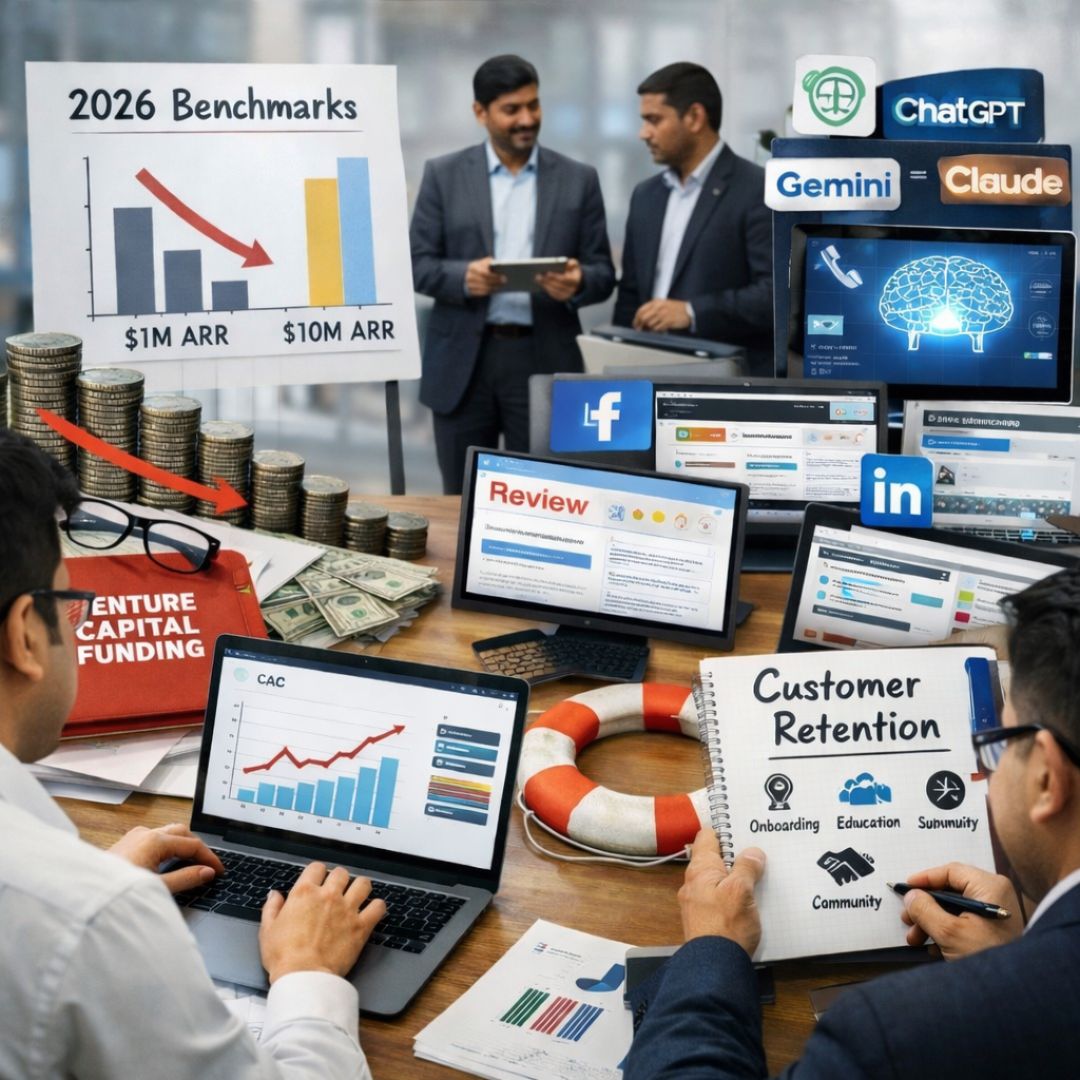
The stakes have never been higher. Venture capital is tighter, customer acquisition costs (CAC) are rising, and buyers are more skeptical than ever. A poorly executed marketing strategy doesn’t just mean slow growth — in 2026, it can mean running out of runway entirely.
Here’s the reality that Angelspire sees daily with our clients: most SaaS companies are great at building products but terrible at marketing them. They build something genuinely useful, then expect growth to happen organically. It doesn’t.
Growth is engineered through modern B2B SaaS marketing strategies that combine SaaS demand generation, conversion optimization, and long-term customer retention.
According to OpenView Partners’ 2025 SaaS Benchmarks Report, companies with a documented marketing strategy grow 30% faster than those without one. That gap is only widening. In 2026, the difference between a company with $1M ARR and one with $10M ARR is rarely the product — it’s almost always the go-to-market strategy.
There are several structural reasons why having a strong B2B SaaS marketing strategy in 2026 matters more than ever. First, the average B2B buyer now consults 7 to 10 different sources before making a purchase decision, according to Forrester Research. If your brand isn’t showing up across those touchpoints — organic search, review platforms, LinkedIn, newsletters, AI-powered search tools — you simply don’t exist in the buyer’s journey.
Second, AI tools like ChatGPT, Gemini, Claude, and Perplexity are increasingly being used as the first stop in the B2B research process. Buyers ask these tools for software recommendations, and if your brand isn’t optimized for AI-powered search and Answer Engine Optimization (AEO), your competitors will capture that demand before you even know it existed.
Third, churn is the silent killer of SaaS businesses. Without a marketing strategy that extends into the customer lifecycle — onboarding content, customer education, community building — even high acquisition numbers can’t save a business hemorrhaging customers out the back door.
Angelspire’s approach to B2B SaaS marketing always starts with a full-funnel audit to identify where the leaks are before we add more water to the bucket.
Key Benefits of a Strong B2B SaaS Marketing Strategy
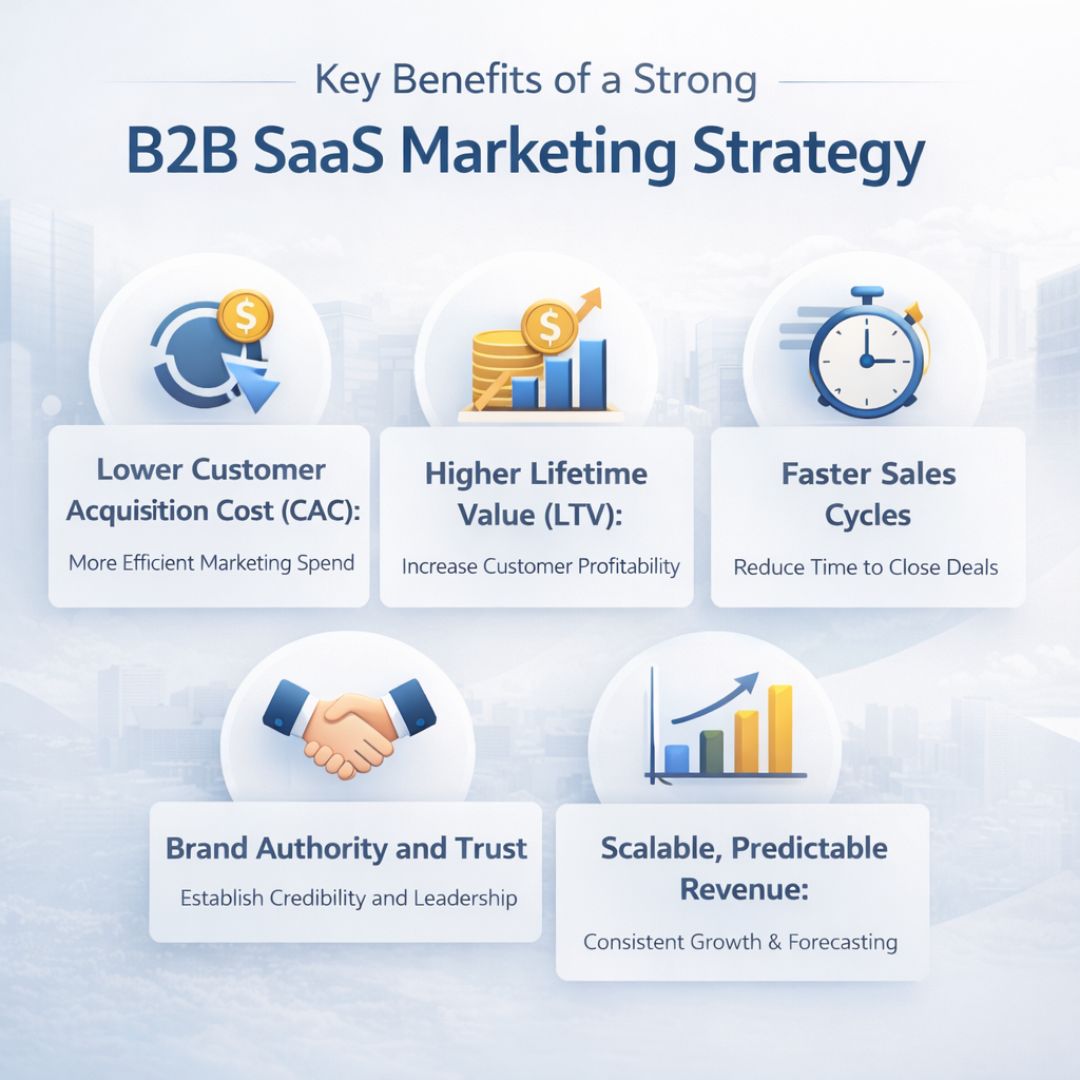
Getting your marketing right pays dividends across every part of the business. These aren’t just vanity metrics — a well-executed B2B SaaS marketing strategy in 2026 produces measurable, compounding business outcomes.
Lower Customer Acquisition Cost (CAC):
When you build strong organic channels — SEO, thought leadership, community — your cost per acquisition drops dramatically over time. Companies with strong content marketing programs see CAC that is 3x to 5x lower than those relying purely on paid acquisition. Angelspire helped one of our SaaS clients reduce their CAC by 47% in 12 months by restructuring their content and SEO strategy around high-intent search queries.
Higher Lifetime Value (LTV):
Marketing that extends into the customer lifecycle — through educational content, webinars, and community touchpoints — creates customers who stay longer and spend more. When customers feel continuously supported and educated, churn rates drop. A 5% reduction in churn can increase profitability by 25% to 95%, according to Bain & Company.
Faster Sales Cycles:
Great B2B SaaS marketing strategies pre-educate buyers through a structured SaaS content marketing strategy that shortens sales cycles and improves B2B SaaS lead generation.
When a prospect arrives at a sales call already understanding your product’s value, already having consumed your case studies and ROI calculators, the sales cycle compresses dramatically. Angelspire’s clients consistently report 20-40% shorter sales cycles after implementing integrated content and demand generation programs.
Brand Authority and Trust
In a crowded market, trust is the ultimate differentiator. A consistent, expert-level content presence — blog posts, podcasts, webinars, LinkedIn thought leadership — positions your brand as the obvious category leader. When buyers trust your brand, they don’t even seriously evaluate your competitors.
Scalable, Predictable Revenue:
The goal of any mature B2B SaaS marketing strategy is to create a revenue engine that is scalable and predictable. When you know that X dollars of marketing investment produces Y pipeline with Z close rate, you can grow with confidence. This is what Angelspire helps SaaS companies build.
Latest Trends and Insights: B2B SaaS Marketing in 2026

The marketing landscape is shifting rapidly. Here are the most important trends defining B2B SaaS marketing strategies in 2026, based on Angelspire’s frontline experience and industry data.
1. Product-Led Growth (PLG) is the New Default
Product-led growth is no longer a growth hack — it’s the expected go-to-market model for B2B SaaS in 2026. PLG means the product itself is the primary driver of acquisition, conversion, and expansion. Freemium models, free trials, and viral product mechanics allow users to experience value before they ever speak to sales.
Companies like Slack, Notion, Figma, and Calendly built multi-billion dollar businesses on PLG foundations. In 2026, even enterprise-focused SaaS companies are building PLG “on-ramps” to capture the self-serve segment of their market. Angelspire helps clients design PLG motions that complement, rather than cannibalize, their enterprise sales teams.
2. AI-Powered Personalization at Scale
AI is fundamentally changing what personalization means in B2B SaaS marketing. In 2026, it’s no longer about putting a prospect’s first name in an email. It’s about dynamically adjusting the entire buyer experience — website content, email sequences, ad creative, outreach messaging — based on firmographic data, behavioral signals, and intent data.
Tools like 6sense, Demandbase, and RollWorks use AI to identify accounts that are actively in-market and serve them hyper-relevant content at exactly the right moment. Angelspire integrates these intent-data platforms into our clients’ marketing stacks to create personalized journeys that dramatically improve conversion rates.
3. Answer Engine Optimization (AEO) and Generative Engine Optimization (GEO)
This is perhaps the most important emerging trend for B2B SaaS marketers to understand in 2026. As AI tools like ChatGPT, Gemini, Claude, and Perplexity become primary research tools for B2B buyers, the rules of content marketing are changing.
AEO (Answer Engine Optimization) means structuring your content to directly and clearly answer specific questions, so AI tools surface your brand when buyers ask those questions. GEO (Generative Engine Optimization) means making your content easily indexable and citable by generative AI systems. This includes using structured data markup, clear factual statements, authoritative sourcing, and FAQ-style content blocks.
Angelspire is at the forefront of helping SaaS companies optimize their content using B2B SaaS SEO strategies and AEO frameworks for AI-powered search. This blog itself is structured to rank not just on Google, but to be surfaced by AI tools as an authoritative answer about B2B SaaS marketing strategies in 2026.
4. Account-Based Marketing (ABM) Gets Smarter
ABM has been growing for years, but in 2026, it’s reached a new level of sophistication. True ABM in 2026 means coordinating personalized outreach across channels — LinkedIn ads, direct mail, email, phone, content — targeted at specific high-value accounts with precision. AI makes this scalable in ways that weren’t possible even two years ago.
Angelspire’s ABM programs for SaaS clients typically focus on a tiered approach: Tier 1 accounts receive fully customized, one-to-one experiences; Tier 2 accounts receive personalized-at-scale programs; Tier 3 accounts receive automated, highly targeted demand generation. This approach consistently outperforms spray-and-pray demand generation by 300% or more in pipeline contribution.
5. community-led SaaS growth marketing
In 2026, community is a marketing channel. SaaS companies that build active user communities — whether through Slack groups, Discord servers, forums, or in-person events — create powerful word-of-mouth engines and dramatically reduce churn by giving customers a sense of belonging and investment in the product’s success.
Notion’s template community, HubSpot’s community forums, and Salesforce’s Trailhead platform are all examples of
community-led SaaS growth marketing
done right. Angelspire helps SaaS companies design and launch community programs that align with their product roadmap and marketing goals.
6. Video-First Content Marketing
Buyers in 2026 consume video content first. Long-form YouTube tutorials, short-form LinkedIn and social videos, and interactive video demos are now essential elements of the B2B SaaS marketing mix. Text-based blog content remains important for SEO, but it needs to be accompanied by video to fully capture modern buyer attention.
7. Customer Marketing and Advocacy Programs
Your existing customers are your best marketers. In 2026, sophisticated B2B SaaS companies are investing heavily in customer advocacy programs — case studies, reference programs, G2/Capterra review generation campaigns, and customer speaker programs at events. Angelspire builds customer marketing programs that turn happy customers into a measurable revenue channel.
Challenges in B2B SaaS Marketing in 2026
Understanding the opportunities is only half the equation. The challenges facing B2B SaaS marketers in 2026 are real, and they need to be addressed head-on. Angelspire believes in honest assessment — here’s what makes B2B SaaS marketing genuinely difficult in 2026.
Rising Competition and Market Noise.
Every B2B category has become more crowded. There are now over 30,000 SaaS products competing for business attention globally. Standing out in this environment requires exceptional positioning, clear differentiation, and a genuinely compelling brand story. Many SaaS companies struggle here because they default to feature-led messaging when they should be leading with outcomes and customer stories.
Longer and More Complex Buying Cycles.
Economic uncertainty in recent years has made B2B buyers more cautious. In 2026, the average enterprise SaaS deal now involves 7 to 10 stakeholders in the buying process, and cycles can stretch to 9-12 months for larger contracts. Marketing must support every stage of this extended journey with relevant, trust-building content — a significant content production challenge for resource-constrained teams.
Attribution Complexity
With buyers touching 10+ channels before converting, understanding which marketing activities are actually driving revenue is extraordinarily complex. Multi-touch attribution models and revenue intelligence platforms like Gong, Clari, and Dreamdata help, but implementation requires significant investment and expertise. Angelspire helps clients set up attribution frameworks that give them accurate signal rather than misleading last-touch data.
Increasing Privacy Restrictions and Third-Party Cookie Deprecation
With Google’s phase-out of third-party cookies now fully implemented and privacy regulations tightening globally (GDPR, CCPA, and newer legislation), retargeting and audience building have become significantly more challenging. SaaS marketers must pivot to first-party data strategies — building owned audiences through email lists, community memberships, and direct relationships.
Talent and Technology Costs.
Building and running a sophisticated B2B SaaS marketing operation requires specialized talent — demand generation experts, content strategists, marketing operations specialists, data analysts, and paid media managers. Combined with the cost of a modern martech stack, marketing investment can be substantial. Many early-stage SaaS companies partner with agencies like Angelspire to access full-stack marketing expertise without the overhead of a large in-house team.
AI Content Saturation.
As AI content generation tools become ubiquitous, the internet is being flooded with mediocre, templated content. This paradoxically makes high-quality, genuinely expert content more valuable and differentiating than ever. Google’s E-E-A-T guidelines — Experience, Expertise, Authoritativeness, and Trustworthiness — are more important in 2026 than they’ve ever been, and gaming them with AI-generated filler content will actively harm your rankings and brand.
Angelspire's Proven Framework for B2B SaaS Marketing Success
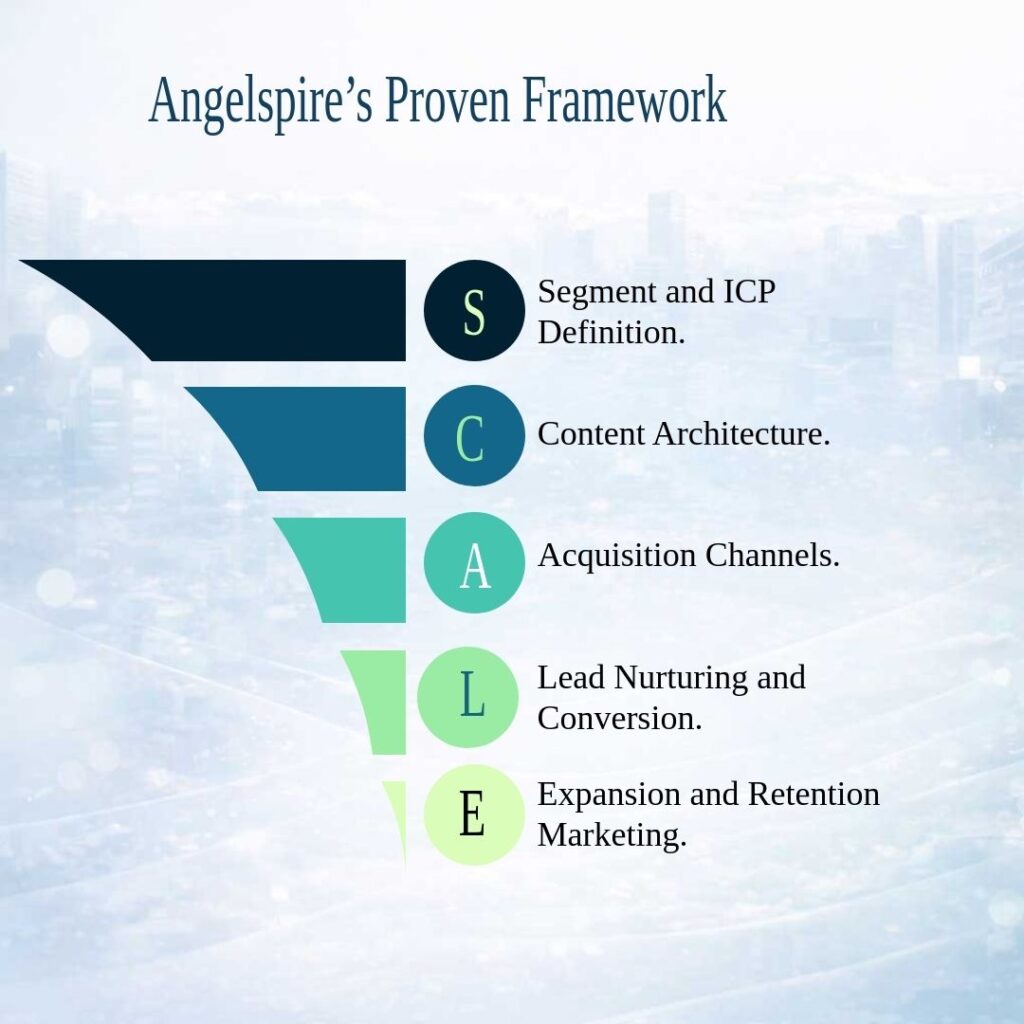
At Angelspire, we’ve distilled our experience working with SaaS companies into a repeatable framework that consistently drives growth. We call it the SCALE Framework:
S – Segment and ICP Definition. Everything begins with a crystal-clear Ideal Customer Profile (ICP). We help clients define their ICP not just by firmographics (industry, company size, location) but by psychographics (goals, fears, buying triggers) and technographics (the tech stack they already use).
C – Content Architecture. We build content ecosystems — not just random blog posts — that map to every stage of the buyer journey, every persona in the buying committee, and every intent signal in the funnel. This includes pillar content, supporting cluster content, AEO-optimized FAQ content, and thought leadership.
A –Best marketing channels for SaaS acquisition. We identify and optimize the right mix of best marketing channels for SaaS acquisition for each client’s stage and target market: organic search (SEO), paid search (SEM), LinkedIn, content syndication, partnerships, and community.
L – Lead Nurturing and Conversion. We design
automated SaaS marketing funnel nurture programs that move prospects through the funnel with the right content at the right time, integrating with the client’s CRM and sales team for a seamless handoff process.
E – Expansion and Retention Marketing. We build customer marketing programs that drive product adoption, expansion revenue, and customer advocacy — turning the customer base into a compounding growth asset.
This framework is what Angelspire brings to every B2B SaaS engagement, and it’s why our clients consistently outperform their competitors in pipeline efficiency and revenue growth.
How to Implement These B2B SaaS Marketing Strategies in 2026
Execution is where most companies fall short. Here’s a practical starting point for implementing a modern B2B SaaS marketing strategy in 2026:
Start by auditing your current state. Where is your pipeline coming from? What’s your CAC by channel? What’s your win rate, and where are prospects dropping out of the funnel? You cannot optimize what you haven’t measured. Angelspire typically begins every client engagement with a 30-day marketing audit that surfaces these answers.
Next, double down on your ICP. The most common mistake Angelspire sees in B2B SaaS marketing is trying to serve too many customer segments simultaneously. The companies that grow fastest are ruthlessly focused on a specific ICP and optimize every element of their go-to-market around that customer archetype.
Then, invest in content that answers real buyer questions. Use tools like Semrush, Ahrefs, and AlsoAsked to identify the exact questions your ICP is typing into Google — and asking AI tools. Create content that answers those questions better than anyone else. This is the foundation of both traditional SEO and emerging AEO/GEO strategies.
From there, build your ABM program for your highest-value accounts, implement your PLG motion if appropriate for your product, and launch a community initiative. These take time to yield results, but they compound in ways that paid acquisition never can.
Finally, don’t neglect your existing customers. The fastest path to more revenue in 2026 is almost always through your current customer base — through expansion, upsell, cross-sell, and referral programs.
B2B SaaS SEO Strategies for Long-Term Organic Growth
Modern B2B SaaS marketing strategies rely heavily on organic visibility because paid acquisition costs continue to rise every year. Companies investing in B2B SaaS SEO strategies are able to attract high-intent buyers consistently without depending entirely on advertising budgets. A strong SaaS content marketing strategy helps businesses rank for informational, commercial, and transactional keywords throughout the customer journey. In 2026, search visibility also includes Answer Engine Optimization (AEO) and AI-powered search platforms like ChatGPT and Gemini. SaaS growth marketing now requires brands to optimize not only for Google rankings but also for AI-generated recommendations. Businesses that build topic authority through educational content, product-led pages, and intent-driven SEO frameworks gain a major advantage in B2B SaaS customer acquisition and long-term pipeline growth.
Account Based Marketing for SaaS Companies in 2026
Account based marketing for SaaS has become one of the most effective approaches for targeting high-value enterprise clients. Instead of marketing to broad audiences, modern B2B SaaS marketing strategies focus on personalized outreach for decision-makers inside specific organizations. This approach improves B2B SaaS lead generation because campaigns are tailored according to company size, industry, pain points, and buying intent. SaaS demand generation campaigns combined with LinkedIn outreach, personalized landing pages, and intent-based advertising produce significantly better conversion rates. The best marketing channels for SaaS now include LinkedIn, email automation, AI-powered personalization tools, and strategic webinar funnels. Companies implementing account based marketing for SaaS consistently achieve higher deal values and shorter sales cycles compared to traditional mass marketing campaigns.
Building a High-Converting SaaS Marketing Funnel
A well-optimized SaaS marketing funnel is essential for sustainable B2B SaaS customer acquisition in 2026. The modern buyer journey is no longer linear, which means SaaS companies must create personalized experiences across awareness, consideration, and decision stages. Effective B2B SaaS marketing strategies use educational content, free trials, webinars, demos, and retargeting campaigns to move prospects through the funnel. SaaS growth marketing teams also focus heavily on behavioral analytics and AI-driven automation to improve conversions at every stage. Combining SaaS content marketing strategy with email nurture sequences and product-led onboarding helps businesses reduce churn while increasing customer lifetime value. The best marketing channels for SaaS funnel optimization include SEO, LinkedIn, YouTube, webinars, and community-led SaaS growth marketing initiatives.
Conclusion: The Future of B2B SaaS Marketing Belongs to the Bold
The B2B SaaS marketing landscape in 2026 rewards companies that are willing to invest in long-term brand building, embrace new technologies like AI-powered personalization and AEO, and create genuinely valuable experiences for their buyers and customers.
The companies that will dominate their categories are those building scalable SaaS marketing funnels and implementing data-driven B2B SaaS customer acquisition systems instead of relying only on isolated campaigns.
At Angelspire, we believe that great marketing is both an art and a science. It requires the creativity to tell compelling stories and the analytical rigor to measure and optimize every touchpoint. We bring both to every client engagement.
The strategies outlined in this guide — product-led growth, AI personalization, account-based marketing, community-led SaaS growth marketing, AEO/GEO optimization, video-first content, and customer advocacy — are not hypothetical. They are the B2B SaaS marketing strategies that are driving real growth for real companies right now, in 2026.
The question isn’t whether these strategies work. The question is whether you’ll implement them before your competitors do.
Ready to Transform Your B2B SaaS Marketing in 2026?
If you’re serious about building a marketing engine that drives predictable, scalable revenue growth, Angelspire is ready to help. Our team of B2B SaaS marketing specialists has helped dozens of SaaS companies grow from early-stage to category leaders.
Here’s your next step: Schedule a free 30-minute Marketing Growth Audit with the Angelspire team. We’ll analyze your current marketing performance, identify your biggest growth opportunities, and share a custom roadmap for scaling your SaaS marketing in 2026.
About The Author
Angel Sargiya
Angel Sargiya is a digital marketing strategist and the founder of Angelspire, a growth-focused agency specializing in SEO, SaaS marketing, content strategy, and AI-driven digital solutions. Passionate about helping brands scale online, Angel combines creativity with data-driven marketing strategies to build strong digital visibility, generate quality leads, and create sustainable business growth in the evolving digital landscape of 2026 and beyond.

You can also explore our full range of B2B SaaS marketing services, read more expert insights on our blog, or follow Angelspire on LinkedIn for daily B2B SaaS marketing strategy content.
Frequently Asked Questions
The biggest SaaS trends in 2026 revolve around AI integration, smarter go-to-market models, and efficiency over growth-at-all-costs. Product-led growth (PLG) has become the default acquisition model for most SaaS companies. AI-powered personalization is now built into nearly every stage of the customer journey — from onboarding to retention. Answer Engine Optimization (AEO) is rising fast as more buyers use ChatGPT, Gemini, and Perplexity to research software. Community-led growth, vertical SaaS (software built for niche industries), and usage-based pricing models are also gaining significant momentum. Companies like Angelspire are helping SaaS brands stay ahead of these shifts with strategies built specifically for 2026’s buyer behavior.
B2B marketing includes any activity that helps a business attract and convert other businesses as customers. Common examples include SEO-driven blog content targeting decision-makers, LinkedIn thought leadership campaigns, email nurture sequences for trial users, webinars that educate potential buyers, account-based marketing (ABM) programs targeting high-value companies, and customer case studies that build trust. For SaaS specifically, free trial campaigns, product demo videos, G2 review generation, and co-marketing partnerships are widely used. Angelspire designs B2B marketing programs that combine several of these channels into a unified, full-funnel strategy rather than relying on any single tactic.
Effective B2B SaaS marketing follows a clear sequence. Start by defining your Ideal Customer Profile (ICP) — who your best-fit customer actually is. Then build messaging that speaks to their specific pain points and goals. Create content that answers their questions at every stage of the buying journey, from awareness to decision. Set up acquisition channels that reach them — typically organic search, LinkedIn, and paid media. Build automated email nurture sequences to move prospects toward a trial or demo. Once they become customers, continue marketing to them through onboarding content, educational resources, and expansion campaigns. Angelspire recommends treating marketing as a full-cycle engine, not just a top-of-funnel activity.
B2B SaaS marketing is the process of promoting and selling cloud-based software products to other businesses. Unlike traditional product marketing that ends at the sale, B2B SaaS marketing covers the entire customer lifecycle — attracting prospects, converting them into paying subscribers, and keeping them engaged long-term to reduce churn. Because SaaS products are subscription-based, retention is just as critical as acquisition. A strong B2B SaaS marketing strategy aligns messaging, content, channels, and customer experience to drive sustainable, predictable revenue growth. Angelspire specializes in building these systems for SaaS companies at every growth stage.
The most common mistake is targeting too broad an audience instead of focusing on a well-defined ICP. Many SaaS companies also lead with features rather than customer outcomes, which fails to connect emotionally with buyers. Over-investing in paid acquisition without building organic channels creates fragile growth that disappears the moment the ad budget is cut. Ignoring existing customers is another major error — most SaaS revenue opportunities live inside the current customer base through upsell and expansion. Finally, neglecting churn through weak onboarding and poor customer success leaves companies constantly refilling a leaky bucket. Angelspire’s audit process is specifically designed to identify and fix these exact issues.
SaaS (Software as a Service) products are cloud-based tools that users access via subscription rather than installing locally. Well-known examples include Salesforce (CRM), HubSpot (marketing and sales), Slack (team communication), Zoom (video conferencing), Notion (productivity and documentation), Shopify (e-commerce), and Figma (design collaboration). In the B2B space, SaaS tools span virtually every business function — from HR (Workday, BambooHR) to finance (QuickBooks Online, Brex) to marketing automation (Marketo, ActiveCampaign). The common thread is that all of them are delivered online, updated continuously, and billed on a recurring basis.
The golden rule of SaaS is simple: deliver continuous value or lose the customer. Unlike a one-time product purchase, SaaS customers renew (or don’t) based on whether the software keeps solving their problem. This makes customer success, product adoption, and ongoing engagement non-negotiable. A related principle is that Net Revenue Retention (NRR) is the truest measure of a healthy SaaS business — if your existing customers are growing their spend with you over time, your business compounds. If they’re churning, no amount of new logo acquisition will save you. At Angelspire, we build marketing strategies around this principle, ensuring retention and expansion are treated with the same urgency as new customer acquisition.